

Kenyon College is a highly regarded private liberal arts college located in Gambier, Ohio, United States. Known for its rigorous academics, close-knit residential campus, and strong emphasis on writing, critical thinking, and interdisciplinary learning, Kenyon attracts students from across the U.S. and around the world. The college’s campus layout and setting play an important role in shaping student life, academic engagement, and community culture.
The purpose of this guide is to provide a comprehensive, student-focused overview of the Kenyon College map and how the physical layout of the campus supports academics, residential life, student services, and extracurricular activities. Understanding the campus map is particularly valuable for prospective students and families, as it offers insight into daily life, accessibility, and the overall learning environment.
This article is intended for local U.S. students considering Kenyon College, international students exploring residential liberal arts colleges in the United States, parents seeking clarity on campus structure and student safety, and education consultants advising students on campus-based academic experiences.
Overview of the University

Background and Establishment
Kenyon College was founded in 1824, making it one of the oldest private liberal arts colleges in the United States. Established with a mission to provide a rigorous classical education, the college has evolved over two centuries while maintaining its commitment to academic excellence, close faculty-student engagement, and residential learning.
The campus was carefully planned to support a self-contained academic community, where learning extends beyond classrooms into residence halls, libraries, and shared spaces.
Vision, Mission, and Academic Philosophy
Kenyon’s mission emphasizes intellectual curiosity, effective communication, ethical reasoning, and lifelong learning. Its academic philosophy is rooted in the liberal arts tradition, encouraging students to explore diverse disciplines while developing depth in their chosen fields.
The campus map reflects this philosophy by integrating academic buildings, residential spaces, and communal areas in close proximity, fostering frequent interaction and collaboration.
Reputation Within the UAE and Internationally
Kenyon College does not operate campuses in the UAE and is not regulated by MOE or KHDA. Internationally, it is well recognized as a prestigious U.S. liberal arts college, particularly respected for humanities, social sciences, natural sciences, and creative writing. Degrees are generally accepted worldwide, subject to credential evaluation requirements.
Campus Overview

Campus Location
Kenyon College is located in Gambier, a small village in central Ohio. The rural setting offers a peaceful, distraction-free environment that supports academic focus while maintaining access to nearby towns and cities for internships and cultural experiences.
Why the Campus Was Established
The campus was established to create a residential academic community where students live and learn together. Its location and layout were intentionally designed to encourage immersion in campus life, strong peer relationships, and close interaction with faculty.
Campus Environment and Learning Atmosphere
Kenyon’s campus environment is cohesive and walkable. Academic buildings, residence halls, dining facilities, libraries, and student centers are centrally located, as reflected on the Kenyon College map. This layout promotes a strong sense of community, ease of navigation, and frequent engagement in academic and social activities.
Accreditation & Recognition
Kenyon College is accredited by recognized regional accrediting bodies in the United States, ensuring academic quality and institutional credibility.
The college is not accredited by MOE or KHDA in the UAE. However, its degrees are widely recognized internationally for employment and further education, subject to local credential evaluation. Graduates are generally eligible for private-sector roles, nonprofit positions, and graduate study. Eligibility for government employment depends on country-specific regulations.
Colleges & Academic Programs Offered
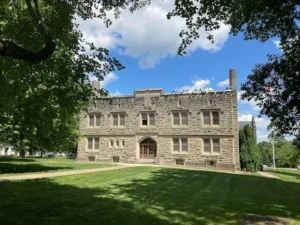
Kenyon College operates as a unified liberal arts institution rather than separate colleges, but academic departments and divisions are clearly represented across the campus map.
Humanities Division
Major Undergraduate Programs Include:
- English
- History
- Philosophy
- Modern languages
- Classics
These departments are often housed near libraries and seminar spaces, emphasizing discussion-based learning.
Social Sciences Division
Major Programs Include:
- Economics
- Political science
- Sociology
- Psychology
- Anthropology
Buildings are designed to support research, collaboration, and data analysis.
Natural Sciences Division
Major Programs Include:
- Biology
- Chemistry
- Physics
- Mathematics
- Environmental studies
Science facilities include laboratories and research spaces, clearly identified on the campus map for ease of access.
Arts Division
Major Programs Include:
- Studio art
- Music
- Drama
- Dance
Performance spaces, studios, and galleries are integrated into the campus layout, supporting creative exploration.
Kenyon primarily offers undergraduate degrees, with limited postgraduate or certificate opportunities through affiliated or special programs.
Admission Requirements

Undergraduate Academic Requirements
Applicants must hold a recognized high school diploma or equivalent. Admissions decisions are holistic and consider:
- Academic transcripts
- Coursework rigor
- Essays and personal statements
- Letters of recommendation
Postgraduate Degree and GPA Requirements
Kenyon College does not offer traditional postgraduate degree programs. Applicants interested in advanced study typically pursue graduate education elsewhere after completing their undergraduate degree.
English Language Requirements
International students must demonstrate English proficiency through IELTS, TOEFL, or equivalent examinations. Required scores align with expectations for rigorous academic writing and discussion.
Transfer Students
Transfer applicants may receive credit for coursework completed at accredited institutions. Credits are evaluated individually based on academic standards and course content.
Tuition Fees & Scholarships
Fee Structure Overview
As a private liberal arts college, Kenyon College’s tuition reflects its residential model, small class sizes, and extensive academic resources. Costs are higher than public universities but include access to campus facilities and student services.
Additional Academic or Administrative Fees
Students should plan for additional costs such as:
- Housing and dining
- Student activity and service fees
- Laboratory or course-specific fees
- Health insurance
- Books and personal expenses
Scholarships, Grants, and Discounts
Kenyon offers merit-based scholarships, need-based financial aid, and institutional grants. Financial aid is designed to support both domestic and international students, with awards based on academic achievement and demonstrated need.
Campus Facilities & Student Life
Kenyon’s campus map highlights key facilities, including classrooms, science labs, performance spaces, and libraries. The library system is central to academic life, offering study areas, research support, and digital resources.
Student services include academic advising, tutoring, counseling, health services, and career development offices. These are strategically located to ensure accessibility for all students.
Student life is active and community-oriented. Clubs, student organizations, cultural events, and campus traditions are spread across common spaces, residence halls, and student centers shown on the campus map.
Faculty & Teaching Approach
Faculty members at Kenyon College hold advanced degrees and are active scholars, writers, and researchers. Many are nationally or internationally recognized in their fields.
Teaching emphasizes seminar-style discussions, close reading, writing-intensive coursework, and undergraduate research. The campus layout supports this approach by placing faculty offices, classrooms, and study spaces near one another.
Curricula are designed to develop analytical thinking, communication skills, and intellectual independence.
Career Opportunities & Industry Connections
Kenyon College supports career preparation through internships, research opportunities, and alumni engagement. While the campus is rural, its map reflects strong internal resources that support professional development.
Career services assist students with:
- Internship and job searches
- Resume and interview preparation
- Graduate school planning
- Alumni networking
The college maintains relationships with employers, nonprofits, and graduate institutions across the U.S. and internationally.
Why Choose This University?

Key advantages of Kenyon College include:
- Strong liberal arts education
- Integrated, walkable campus
- Close faculty-student relationships
- Residential learning community
Kenyon is ideal for students who value academic immersion, community engagement, and a thoughtfully designed campus environment.
Pros & Cons
Pros
- Highly cohesive and navigable campus
- Strong academic reputation
- Personalized learning experience
- Active campus life and traditions
Cons
- Rural location may feel isolated to some students
- Limited postgraduate offerings
- Higher cost compared to public universities
Frequently Asked Questions
Q1. Is the university accredited?
A. Yes, Kenyon College is accredited by recognized U.S. accrediting bodies.
Q2. Are degrees internationally recognized?
A. Yes, degrees are generally recognized internationally, subject to credential evaluation.
Q3. Can international students apply?
A. Yes, Kenyon welcomes international students and provides dedicated support services.
Q4. Is accommodation available?
A. Yes, on campus housing is a core part of the Kenyon experience, with most students living on campus.
Conclusion
Understanding the Kenyon College map provides valuable insight into how the college’s physical layout supports its academic philosophy, residential culture, and student engagement. The campus is intentionally designed to foster community, intellectual focus, and meaningful interaction among students and faculty.
Prospective students are encouraged to explore the campus map alongside academic offerings, housing options, and student services. Visiting the campus, attending information sessions, and requesting additional materials can help determine whether Kenyon College aligns with personal, academic, and career goals.